Genesis 25:19–28:9 in Bible Word Study: hear every word and open its dictionary entry.
Parashat Toldot Drash The Covenant That Holds 14.11.2026
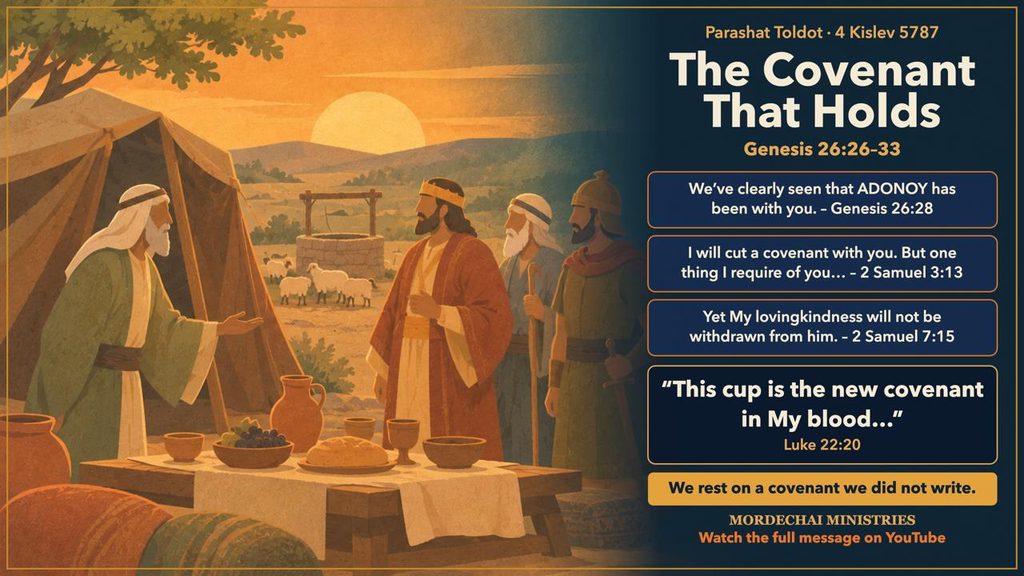
Drash — The Covenant That Holds
Just before our reading, Isaac had very little to lean on. There was famine in the land. He had been envied, sent away from Gerar, and pushed off one well after another. Then, one night, ADONOY spoke to him:
Do not be afraid, for I am with you, and I will bless you and multiply your seed for the sake of Abraham my servant. Genesis 26:24
Then the king who had sent him away arrives at his tent, with his adviser and the commander of his army. Isaac does not pretend:
Why have you come to me, since you hate me and sent me away from you? Genesis 26:27
And the king answers:
We’ve clearly seen that ADONOY has been with you… let us make a covenant with you. Genesis 26:28
This morning we look at that one word: covenant.
A covenant is a bond
In the Bible, a covenant is a bond. It ties one life to another by a solemn oath. So whenever we meet the word, two questions matter. Who is being tied to whom? And on what terms?
The king came to the shepherd
Notice who asks. Isaac did not go looking for this treaty. A king with an army came to a shepherd with a tent, and the reason he gave was not Isaac’s wealth. It was this: “ADONOY has been with you.” What God had promised Isaac in private, a foreign king now says aloud: “You are now blessed by ADONOY” (Genesis 26:29).
It had happened before. A king of Gerar had come to Abraham with the same request, for the same reason (Genesis 21:22). The medieval sage Rashi hears that in the king’s words: we saw it with your father, and we see it with you.
Notice also how Isaac answers. He names the hatred honestly. The king replies that they did him “nothing… but good”. The sages caught that phrase, and said the good was only partial. Isaac lets it pass. He does not try to win the argument. He sets a table.
Then he made a feast for them and they ate and drank. Genesis 26:30
In the morning they swear to one another.
Then Isaac sent them away and they departed from him in shalom. Genesis 26:31
Isaac’s blessing did not end in victory over his enemy. It ended in peace with him. And that same day his servants came with news: “We’ve found water” (Genesis 26:32).
When one’s ways are pleasing to ADONOY, he makes even his enemies be at peace with him. Proverbs 16:7
Why Moses said no
But here is a question. Generations later, Moses commands Israel:
Make no covenant with them or with their gods. They must not dwell in your land and cause you to sin against Me, for if you worship their gods, they will be a snare to you. Exodus 23:32–33
Did Abraham and Isaac do wrong? The sages felt the weight of that question. One ancient Jewish teaching even has God say to Abraham that his gift to Abimelech was given “against My wishes”. They knew that a bond with a neighbour is never a small thing.
Yet look at what Moses forbids, and why. He joins two things in one breath: “with them or with their gods.” The danger is a bond that pulls the heart away from ADONOY. Deuteronomy gives the reason plainly: “he will turn your son away from following Me to serve other gods” (Deuteronomy 7:4).
Now look again at Isaac’s tent. Here the order is the reverse of Moses’ fear. Abimelech comes to Isaac confessing that ADONOY is with him. Nobody is drawing Isaac toward the gods of Gerar. The king is being drawn toward the God of Isaac.
So the lesson is not that we never make peace with those outside. It is that we know what we are binding ourselves to. Peace with a neighbour, yes. A bond with his gods, never.
“One thing I require”
There is another covenant worth setting beside this one. Years later Abner, the commander of Saul’s army, sends word to David: make your covenant with me, and I will bring all Israel over to you. David answers:
Good! I will cut a covenant with you. But one thing I require of you… 2 Samuel 3:13
That is how we make covenants. Even David, a man after God’s heart, with a fair request. There is a price before there is a bond. I will, if you will. And our bonds are only as strong as we are. Before that chapter ends, Abner lies dead, and David is weeping at his grave.
Now hear what happens when ADONOY makes a covenant with that same David. David asked for nothing. God spoke first, and promised him a house and a throne forever. And of David’s son He said:
If he commits iniquity, I will correct him with the rod of men and with the strokes from sons of men. Yet My lovingkindness will not be withdrawn from him. 2 Samuel 7:14–15
Do we hear the difference? David says, “One thing I require.” ADONOY says, “My lovingkindness will not be withdrawn.” There is correction, because He is a Father. But He does not walk away.
The covenant that holds
This is how ADONOY has always bound Himself to His people. Isaac heard it in the famine: “I will confirm my pledge that I swore to Abraham your father” (Genesis 26:3). Israel heard it even in the warning of exile:
Yet for all that, when they are in the land of their enemies, I will not reject them, nor will I hate them into utter destruction, and break My covenant with them, for I am ADONOY their God. Leviticus 26:44
And through Jeremiah He promised still more:
Behold, days are coming… when I will make a new covenant with the house of Israel and with the house of Judah. Jeremiah 31:30
A new covenant, with the same people, from the same faithful God. And on the night He was betrayed, at a table, Yeshua took the cup:
This cup is the new covenant in My blood, which is poured out for you. Luke 22:20
Isaac sealed a covenant by setting a table for men who had wronged him. Yeshua set a table for disciples who would leave Him that very night, and He paid the price Himself. He did not say, “One thing I require of you.” He said, “poured out for you.”
God has not taken back His word to Israel, “for the gifts and the calling of God are irrevocable” (Romans 11:29). And those of us from the nations come as Abimelech came, saying, “We have seen that ADONOY is with you.”
For us today
What does this ask of us? Three things.
First, we can live so that it shows. Isaac did not chase the king’s favour. He stayed where God told him to stay, dug his wells, built his altar and called on the Name. The king came to him. In anxious and angry days, people notice a home where ADONOY is present.
Second, we can be the ones who set the table. When someone who wronged us comes halfway, we do not have to win the history. We can tell the truth, as Isaac did, and then make room.
If possible, so far as it depends on you, live in shalom with all people. Romans 12:18
Third, we watch what we bind ourselves to. In business, in friendship, in marriage, in whatever asks for our loyalty: peace with all, but no bond that pulls our hearts from Him.
And we can do all three without fear, for one reason. Our security does not rest on any agreement we have signed. It rests on a covenant we did not write, sworn by the God who keeps His word, and sealed in the blood of Messiah. Isaac could afford to be generous to Abimelech because he had already heard, “Do not be afraid, for I am with you.” We have heard it too.
So when the knock comes at our tent, may we answer as Isaac did: honest about the past, generous at the table, and at rest in the God whose covenant holds.
And let us say: Amen.
Prayers
Bless ADONOY, O my soul,
and all that is within me, bless His holy Name.
Bless ADONOY, O my soul,
and forget not all His benefits:
Psalm 103:1–2