Genesis 6:9–11:32 in Bible Word Study: hear every word and open its dictionary entry.
Parashat Noach Drash A Covenant We Did Not Have to Earn
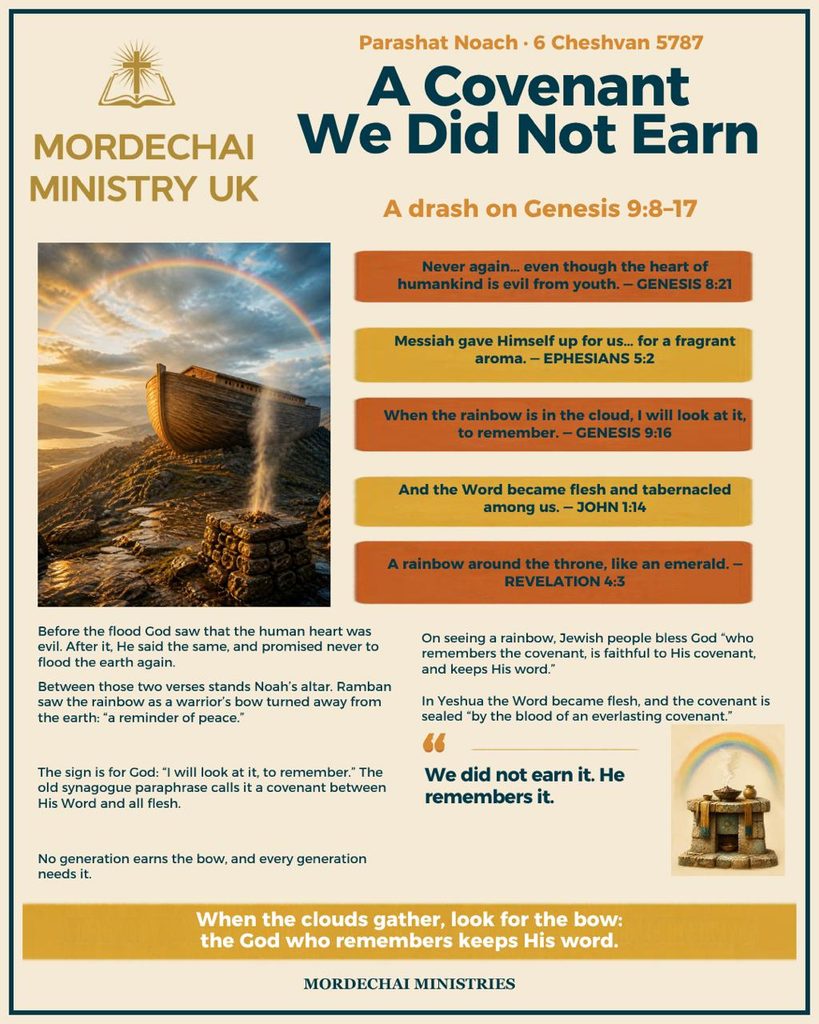
Drash — A Covenant We Did Not Have to Earn
Picture Noah stepping out of the ark. The ground is still wet. Everything he knew is gone. And then, a few days later, the first clouds roll in over the mountains. What did Noah feel when he saw them?
This morning God answers that fear with a bow in the cloud. And the question for us is simple: what holds the world together after the flood? The answer is not Noah, and it is not us. It is a covenant we did not have to earn.
The same heart
Before the flood, God looked at humanity and saw that every intention of the human heart was only evil, all the time (Genesis 6:5). That was the reason for the flood. Now listen to what God says after it:
When ADONOY smelled the soothing aroma, ADONOY said in His heart, “I will never again curse the ground on account of man, even though the inclination of the heart of humankind is evil from youth.” Genesis 8:21
It is the same heart. Joseph Shulam of Netivyah in Jerusalem calls the likeness between these two verses shocking. The flood washed the earth, but it did not change us. Claus Westermann puts it plainly: “God decides to put up with this state of evil.” Paul says the same of every one of us:
For all have sinned and fall short of the glory of God. Romans 3:23
So if the heart did not change, what did? Between the two verses stands an altar.
An altar and an aroma
The first thing Noah built in the new world was an altar, and the first thing he did was worship. Scholars argue over whether his offering was thanksgiving or atonement. Scripture holds both. And “soothing aroma” is the Bible’s phrase for an offering God receives with pleasure. When Paul wanted to describe what Messiah did for us, he used the very words the Greek Bible uses here:
…just as Messiah also loved us and gave Himself up for us as an offering and sacrifice to God for a fragrant aroma. Ephesians 5:2
Then God set His bow in the cloud. The medieval sage Ramban noticed that the rainbow curves with its ends pointing down, “to show that they are not shooting at the earth from the heavens.” It is “the way of warriors to invert the instruments of war” when they make peace. The bow has no string and no arrow. It is, he says, “a reminder of peace.”
But a bow laid down is patience, not yet payment. Franz Delitzsch said that after the flood “the era of patience is to begin now.” Paul tells us where that patience was finally settled:
God set forth Yeshua as an atonement, through faith in His blood, to show His righteousness in passing over sins already committed. Through God’s forbearance, He demonstrates His righteousness at the present time. Romans 3:25–26
The bow was hung up in patience. At the cross that patience was paid for in full.
The God who remembers
Notice who the sign is for. “When the rainbow is in the cloud, I will look at it, to remember” (Genesis 9:16). God does not say, “You must look at it and remember to be good.” He says, “I will.” As Walther Zimmerli wrote, the preservation of humanity and of life “is completely and unreservedly in God’s hands; He remembers it.”
That is why, for centuries, Jewish people seeing a rainbow have blessed God “who remembers the covenant, is faithful to His covenant, and keeps His word.” And it is why Zechariah could sing when Messiah was coming:
So He shows mercy to our fathers and remembers His holy covenant. Luke 1:72
If we are faithless, He remains faithful, for He cannot deny Himself. 2 Timothy 2:13
There is something more. The old Aramaic paraphrase that was read aloud in the synagogues renders this covenant as made “between My Word and all flesh.” Alfred Edersheim, himself a Jewish believer, judged that this “Word” undoubtedly means God revealing Himself, and David Stern links it directly to John’s Gospel. A covenant between the Word of God and all flesh. And then:
And the Word became flesh and tabernacled among us. John 1:14
Yeshua stands on both sides of the covenant: God’s faithfulness and our humanity in one person. That is why it cannot fail.
The generation without a rainbow
Rashi records a beautiful tradition: some generations were so righteous that no rainbow appeared in their days, the generation of King Hezekiah and the generation of Rabbi Shimon bar Yochai. They did not need the reminder.
It is a lovely longing, and it is our longing too: to be good enough not to need mercy. But even Noah was not that generation. Joseph Shulam reminds us that Noah was righteous compared with the people around him, and within a few verses he is lying drunk in his tent. Noah did not stand by his own goodness either:
Through faith he condemned the world and became an heir of the righteousness that comes by faith. Hebrews 11:7
No generation earns the bow, and every generation needs it. Paul, who loved the Torah, learned the same lesson. He no longer wanted a righteousness of his own making, but the righteousness that comes from God, received by trusting in Messiah (Philippians 3:9).
The everlasting covenant
Our Haftarah takes Noah’s oath and turns it into a promise to Israel:
For as I swore that the waters of Noah should no more cover the earth, so I have sworn that I will not be angry with you, nor will I rebuke you. Though the mountains depart and the hills be shaken, My love will not depart from you, nor will My covenant of peace be shaken, says ADONOY who has compassion on you. Isaiah 54:9–10
The perpetual covenant of Genesis 9 comes back at the end of the letter to the Hebrews, now sealed in blood:
Now may the God of shalom, who brought up from the dead the great Shepherd of the sheep by the blood of an everlasting covenant, our Lord Yeshua… Hebrews 13:20
The rainbow around the throne
When John was taken up into heaven, he saw this:
And the One who was seated was like jasper and carnelian in appearance, and a rainbow around the throne, like an emerald in appearance. Revelation 4:3
The throne of the Judge of all the earth is ringed with the sign of His covenant mercy. So we do not need to fear the clouds. We can come close:
Therefore let us draw near to the throne of grace with boldness, so that we may receive mercy and find grace for help in time of need. Hebrews 4:16
So this week, when the clouds gather over our lives, and when we next see a rainbow over our streets, let us stop and bless the God who remembers His covenant and keeps His word. Let us rest in a covenant we did not earn and cannot break. And let us offer our lives back to Him in thanks, as Noah did at his altar, so that our lives too may rise to Him as a fragrant aroma.
And let us say: Amen.
Prayers
Bless ADONOY, O my soul,
and all that is within me, bless His holy Name.
Bless ADONOY, O my soul,
and forget not all His benefits:
Psalm 103:1–2