Genesis 12:1–17:27 in Bible Word Study: hear every word and open its dictionary entry.
Parashat Lech Lecha Drash The Fire in the Darkness 23.10.2026
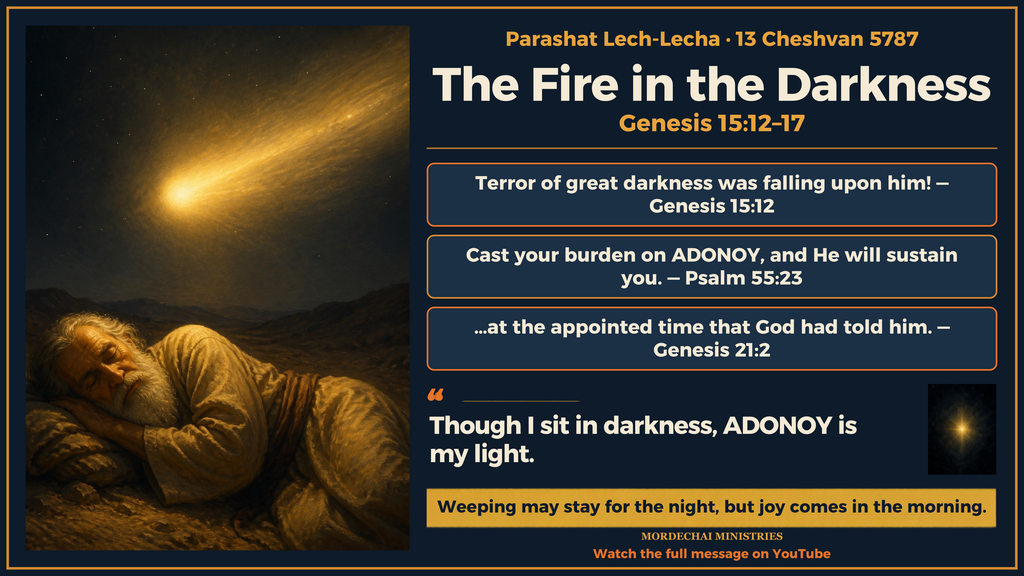
Drash — The Fire in the Darkness
Shabbat shalom.
There is a darkness that is not outside us but within. It comes when sorrow will not lift, when the night seems to have no morning, when we pray and heaven is silent. It is lonely, because no one around us can quite reach into it. And it feels endless. Some of us are walking through that darkness this morning. Others have walked it, and will walk it again. This week’s parashah does not explain the darkness away. It takes us straight into it, and shows us three things: what God is doing in the darkness, how we pray in the darkness, and how He brings us out at His appointed time.
The darkness falls
Abram had obeyed God. He left his land and his father’s house, and the first thing waiting for him in the land of promise was famine (Genesis 12:10). Then came war. Then year after year of empty waiting, with no child. Now God tells him to lay out the covenant animals, and Abram waits. Alfred Edersheim, himself a Jewish believer, pictures that long, lonely day: Abram alone under the sun, driving the birds of prey away from the carcasses, and no one coming. Then, as the sun went down:
When the sun was about to set and a deep sleep fell on Abram, behold, terror of great darkness was falling upon him! Genesis 15:12
The Hebrew is stark. It piles the words on top of each other, terror, darkness, great, with nothing to soften them. And notice this: the sleep “fell” once, but the terror “was falling”. It kept coming down, wave after wave. That is exactly how deep sorrow feels. It is not one blow. It is a crushing weight that keeps settling on us, night after night.
Edersheim saw that the darkness itself carried a message. The lonely day, the circling birds and the horror at nightfall all pictured what God then foretold: four hundred years of slavery and oppression in Egypt. Abram was made to feel, in his own body, the long night his children would pass through. Our darkness is not proof that God has left us. Sometimes it is the very place where He is writing our story.
God in the darkness
Then the sun set completely, and thick darkness came.
When the sun set and it became dark, behold, there was a smoking oven and a fiery torch that passed between these pieces. Genesis 15:17
In the ancient world, both parties to a covenant walked between the pieces, calling down on themselves the fate of the slain animals if they ever broke their word (Jeremiah 34:18). When the parties were unequal, it was the weaker one who walked. Here the Almighty walks, and He walks alone, while Abram lies powerless on the ground. Edersheim calls it a covenant of grace, “in which one party only—God—undertook all the obligations, while the other received all the benefits.”
Mark the moment. The answer did not come when the darkness began. It came when the darkness was at its thickest. And the word for that fiery torch is the word for the lightning flashes at Sinai (Exodus 20:18). In the blackest hour, the fire of the covenant God was right there, binding Himself to a man who could do nothing at all. The prophet speaks to everyone who walks this road:
Who among you fears ADONOY? Who hears the voice of His servant? Who walks in darkness and has no light?
Let him trust in the Name of ADONOY and lean on his God. Isaiah 50:10
The deepest darkness
No one has gone deeper into this darkness than Messiah. In Gethsemane He said, “My soul is deeply grieved, even to the point of death” (Matthew 26:38). An old commentary hears in His anguish the same “horror of great darkness” that fell on Abram. And like Abram, His friends fell asleep. He was utterly alone. Then came the cross:
Now from the sixth hour, darkness fell upon all the land until the ninth hour.
About the ninth hour Yeshua cried out with a loud voice, saying, “Eli, Eli, lema sabachthani?” that is, “My God, My God, why have You abandoned Me?” Matthew 27:45–46
Three hours of darkness at midday. Abandonment. Silence from heaven. He went further into the dark than any of us will ever go, and He went alone, so that we would never be alone in ours. Yet even there He prayed, “My God.” The same commentary puts it simply: “No answer came from the darkened heaven; but the cry was heard.” The psalm He was praying ends the same way:
For He has not despised or disdained the suffering of the lowly one.
Nor has He hidden His face from him, but when he cried to Him, He heard. Psalm 22:25
Prayer in the darkness
King David knew this darkness too. In Psalm 55 the same Hebrew word for dread, with the same verb, “to fall”, comes crashing down on him:
My heart shudders within me and the terrors of death sweep over me. Psalm 55:5
Imagine those words leaving his mouth. This is not a poet choosing fine phrases. It is a man at the end of himself, too tired to fight and too frightened to stay, whispering the one thing left in his heart:
So I said, “Oh that I had wings like a dove! I would fly away and find rest. Psalm 55:7
And the deepest wound came from his closest friend, the companion he once walked with to the house of God (Psalm 55:13–15). This is lonely, dark, endless sorrow: betrayed, terrified, longing only to escape. Yet David does not run. He prays. Not once, but at every hour of the day:
As for me, I will call on God, and ADONOY will save me.
Evening, morning and noon, I complain and moan, then He hears my voice. Psalm 55:17–18
That is how we pray in the darkness: honestly, with groaning, again and again, evening, morning and noon. And then comes the turn:
Cast your burden on ADONOY, and He will sustain you. He will never let the righteous be shaken. Psalm 55:23
Every word of this verse is weighed elsewhere in Scripture.
“Cast” is a violent word: fling it, do not lay it down gently. It is the word used when Joseph’s brothers cast him into the pit (Genesis 37:22–24), and when Hagar cast her dying child under a bush in the wilderness (Genesis 21:15). It is the word David uses of his own life: “From the womb I was cast on You—from my mother’s womb You have been my God” (Psalm 22:11). A son thrown into a pit, a mother in the desert, a child cast on God from birth. In every case God was already there.
“Burden” is a word found nowhere else in the whole Bible. It means “what is given”: our portion, the load God has allowed us to carry. And whatever He has given us to carry, we may fling back on Him. “Commit your way to ADONOY. Trust in Him, and He will do it” (Psalm 37:5).
“Sustain” is the very word for Joseph feeding his family through the famine (Genesis 45:11; 50:21). It is the ravens and the widow feeding Elijah in the drought (1 Kings 17:4, 9). It is God sustaining Israel forty years in the wilderness, so that they lacked nothing (Nehemiah 9:21). Do we see it? Joseph, once cast into the darkness of the pit, became the one who sustained his brothers through the famine. God does not always end the famine at once. He feeds us all the way through it.
And “shaken” is the foot giving way under us. God’s answer is: never. “He will not let your foot slip. Your Keeper will not slumber” (Psalm 121:3). Abram slept. The disciples slept. Our Keeper never does.
Deliverance at the appointed time
The darkness has an end, and God has already fixed the hour.
So Sarah became pregnant and gave birth to a son for Abraham in his old age, at the appointed time that God had told him. Genesis 21:2
“Appointed time” is the very word the Torah uses for the feasts of ADONOY. The God who keeps His calendar keeps His promises. Abraham waited twenty-five years from the call to the cradle. In the night he could not see the morning. But the morning came on the day God had set.
This week’s haftarah opens with Israel’s own cry from the dark:
Why do you say, O Jacob, and assert, O Israel, “My way is hidden from ADONOY,
and the justice due me escapes the notice of my God”? Isaiah 40:27
And God answers:
but they who wait for ADONOY will renew their strength. They will soar up with wings as eagles.
They will run, and not grow weary. They will walk, and not be faint. Isaiah 40:31
David longed for the wings of a dove to flee. God promises the wings of an eagle to rise. The same appointed time stands over Israel’s future:
You will arise and have compassion on Zion, for it is time to show favor to her, for the appointed time has come. Psalm 102:14
The faithfulness that brought Isaac at the appointed time has never let go of Israel. And it will not let go of us.
So if the darkness is falling on some of us this morning, lonely, crushing and seemingly endless, let us hear the word of ADONOY. God is at work in the dark, even when we can do nothing. He walked between the pieces alone. Messiah has gone deeper into the darkness than we ever will, and His cry was heard. So let us pray through the night, evening, morning and noon. Let us fling the load He gave us back on Him, for He will sustain us through the famine. And let us wait for His appointed time, because it is fixed, and it will come.
Do not rejoice over me, O my enemy. Though I have fallen—I will arise. Though I sit in darkness, ADONOY is my light. Micah 7:8
For His anger lasts for only a moment, His favor is for a lifetime.
Weeping may stay for the night, but joy comes in the morning. Psalm 30:6
And let us say: Amen.
Prayers
Bless ADONOY, O my soul,
and all that is within me, bless His holy Name.
Bless ADONOY, O my soul,
and forget not all His benefits: Psalm 103:1–2