Genesis 18:1–22:24 in Bible Word Study: hear every word and open its dictionary entry.
Parashat Vayera Drash The First Prophet Was an Intercessor 31.10.2026
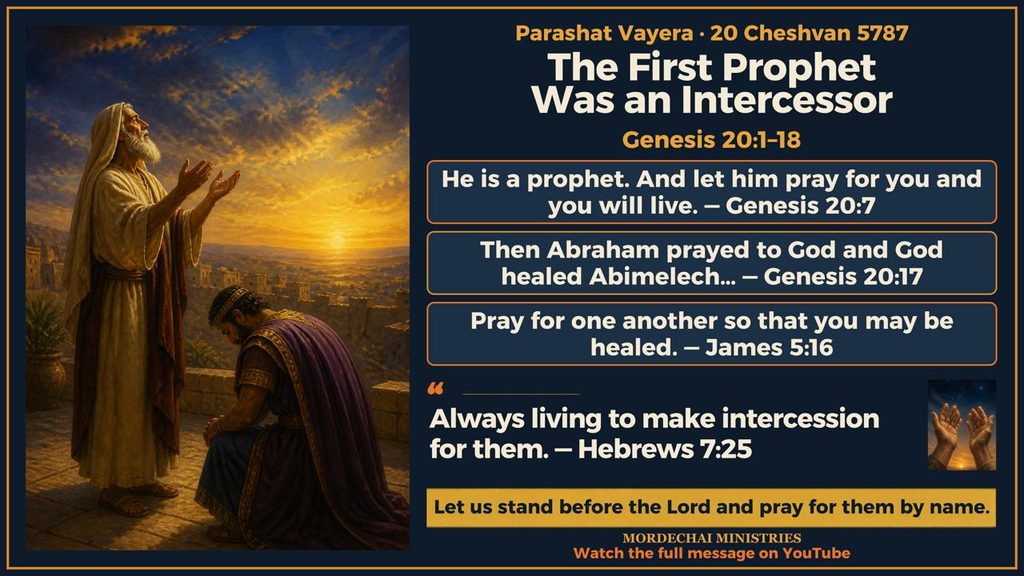
Parashat Vayera — 20 Cheshvan 5787 / 31 October 2026
Genesis 20:1–18 — “The First Prophet Was an Intercessor”
Who was the first person in the Bible to be called a prophet? We might guess Moses, or Samuel, or Elijah. But the first time the word appears in Scripture, God uses it of Abraham. And He says it to a pagan king, on the morning after Abraham has told a half-truth.
So now, return the man’s wife, for he is a prophet. And let him pray for you and you will live. Genesis 20:7
Notice what this first prophet does. He does not foretell the future. He does not preach to Gerar. He prays for someone else, and that person lives.
A king who feared God
Abraham comes to Gerar and repeats what he once did in Egypt: “She is my sister.” Sarah is taken into the king’s house. Then God comes to Abimelech in a dream, and the king answers with more integrity than we might expect.
I did this with integrity of my heart and guiltlessness of my hands. Genesis 20:5
God agrees with him. He tells the king that He Himself kept him from sinning. Abimelech rises early, tells his servants everything, and the whole court is afraid. The pagan king fears God faster than anyone expected.
No excuses
When Abimelech confronts Abraham, the answer comes in three parts.
Because I thought, ‘There is certainly no fear of God in this place, so they’ll kill me, because of my wife.’ Genesis 20:11
First, fear. Second, a technicality: she really is his half-sister (Genesis 20:12). Third, a habit: this was their arrangement in every place they went (Genesis 20:13). Fear, a technicality, a habit. We know all three, because we use them too.
The scholars point out that Scripture gives Abraham every excuse, only to show that none of them clears him. The man God calls a prophet is in the wrong, and the man he wronged is the more upright of the two.
And yet God does not send Abimelech to a better man. He sends him to Abraham.
“Let him pray for you and you will live”
Scholars still debate the root meaning of the word prophet. Some say it means “one who is called”, others “one who speaks for God”. But every one of them agrees on what this prophet does in Genesis 20. He prays for another.
Then Abraham prayed to God and God healed Abimelech, his wife and his female slaves so that they could bear children. Genesis 20:17
The old Aramaic paraphrase read in the synagogues puts it beautifully: Abraham prayed before the Lord. To intercede is to stand before God in someone else’s place.
From Gerar a long line of intercessors begins. Moses stood in the gap for Israel and for Aaron. Samuel said it would be a sin against the Lord to stop praying for his people (1 Samuel 12:23). Jeremiah prayed for Jerusalem until God Himself told him to stop. Even the Psalms look back on Abraham and his family as God’s prophets (Psalm 105:15).
The sages of the Talmud noticed something more. Abimelech paid in sheep, cattle, slaves and silver, but that was not enough. He still needed the prayer of the man he had wronged. And Abraham, who had also been wronged, chose to pray. For the rabbis, Abraham’s prayer was his forgiveness. They add that while Abraham prayed for another man’s house to be blessed with children, his own tent was still empty, and the very next verse tells us that ADONOY visited Sarah (Genesis 21:1).
Our calling
If God used Abraham at his weakest, He can use us. James says so plainly:
So confess your offenses to one another and pray for one another so that you may be healed. The effective prayer of a righteous person is very powerful. James 5:16
Elijah was a man with a nature like ours, and he prayed earnestly that it might not rain. James 5:17
A nature like ours. Elijah was not a superman, and neither was Abraham. Our failures do not cancel our calling to pray. They are often what teach us to pray for others with mercy.
Abraham prayed for a king of the nations. Paul asks the same of us:
Therefore, first of all I urge that requests, prayers, intercessions, and thanksgivings be made on behalf of all people—for kings and all who are in authority—so we may live a peaceful and quiet life in all godliness and respectfulness. 1 Timothy 2:1–2
Then he reminds us whose prayer stands behind all of ours:
For there is one God and there is one Mediator between God and men—a human, Messiah Yeshua. 1 Timothy 2:5
Therefore He is also able to save completely those who draw near to God through Him, always living to make intercession for them. Hebrews 7:25
We are not the Mediator. Messiah Yeshua is, and He never stops praying for us. But because He intercedes for us, we can stand before God for one another. The line that began with Abraham in Gerar runs through Moses, Samuel and Jeremiah to Israel’s Messiah, and from Him to us.
So this week, let us ask ourselves who our Abimelech is. Perhaps someone who has wronged us, or someone we have wronged. Perhaps a family member who does not yet know the Lord, or a leader in our nation, or the people of Israel. Let us not wait until we feel worthy. Let us stand before the Lord and pray for them by name, and trust the God who heals.
And let us say: Amen.
Prayers
Bless ADONOY, O my soul,
and all that is within me, bless His holy Name.
Bless ADONOY, O my soul,
and forget not all His benefits: Psalm 103:1–2